Blog

Improve your emotional & mental health now!

I’m Here to Stay – The Voice of Menopause

I had a session with my mentor, Jade Barbee, recently. We did two sessions and I wanted to write about how transformative they were. These sessions utilized advanced art of delivery skills.

First session on Grief & Menopause ( 30 mins)

In the first session we touched upon how I had not been able to process the grief that came with cancer, and there was a lot of it.

We started the session by tapping on my frustration about the medicines and how the induced menopause was making me feel.

After tapping on it, Jade asked, "If the menopause had a voice then what would it say?" (Often times asking the body part how it feels or giving it a voice helps.)


We tapped on my answer:

"Even though It’s unfair, I'm willing to sit with it."

What came up was,

"This menopause has been imposed on me"

"Feels like I’m giving away my authority to the doctors who are prescribing medicines"

After several rounds on this upon testing, what came up was:

I’m here to stay.”


So we tapped on

I’m here to stay, and Jade added a practitioner reframe which landed well - We can call a truce.

Then we tapped on the cognitive shift.

“Let me make peace with it. Let’s coexist.”

It felt very relieving to say this. It gave me strength.

The session was closed by doing some rounds of silent tapping.


Second session on Grief ( 30 mins)


We began the session by inquiring about my grief. Jade gently opened the session by asking,

“What are you noticing about your grief today? “

I showed him the doodle I had sketched a day before.
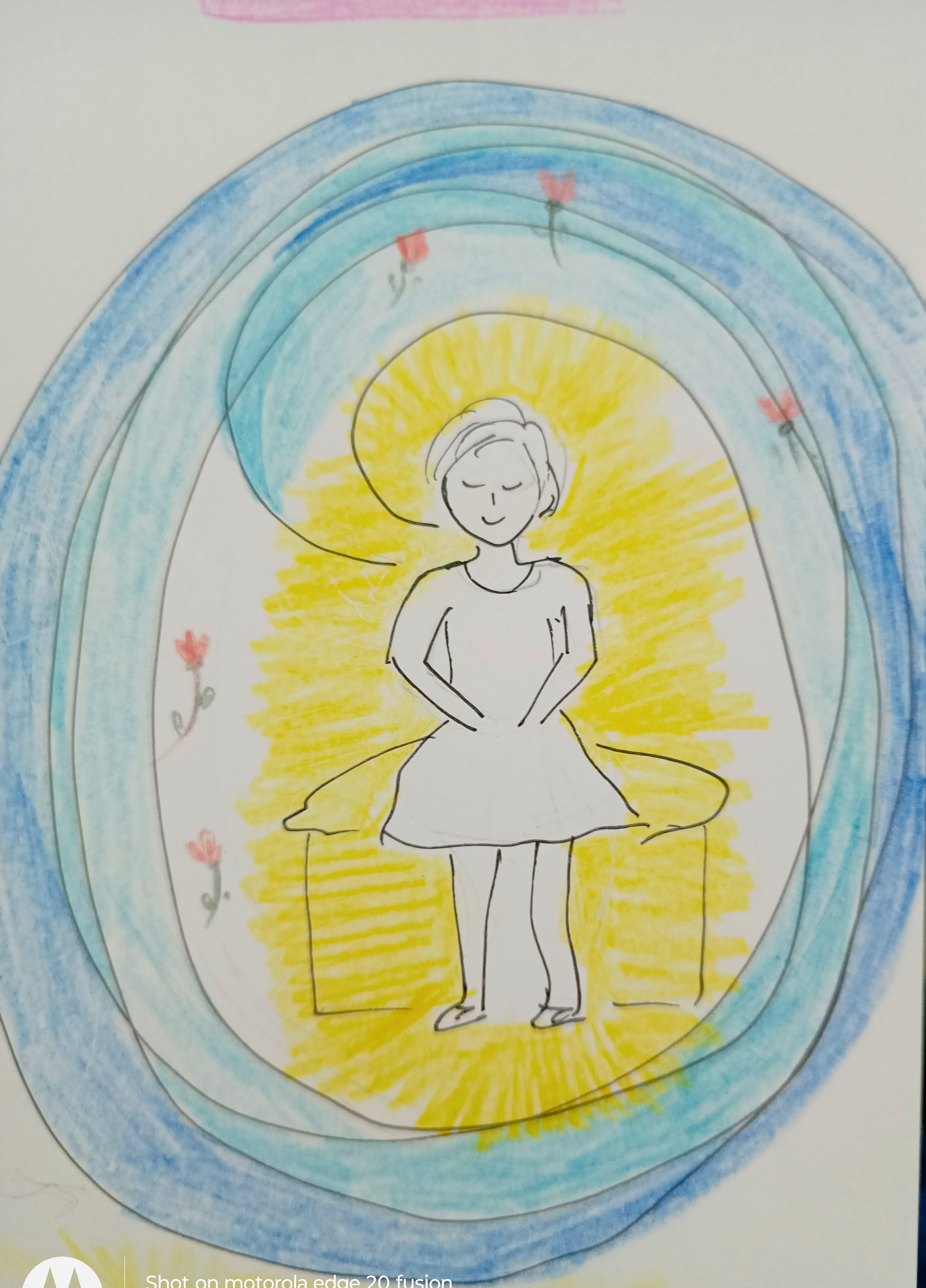
Image of a girl with light around her and light blue colour around it.


He asked me what I was seeing in the image.

I said, “I feel something around me, something blackish and bluish in this painting"

He asked me to check about my willingness to sit with it.

I said that, I'm using positivity to push it away.  Pushing away the grief.


We started tapping on this. Jade was gently guiding me through the sequence of points with some phrases from what I was noticing in the image/painting.

Jade asked, “Is there any part of you that feels that it doesn’t want the grief? “

I said, “Yes, a part of me fears the grief”

We did a few rounds of just touching the points and saying:

This part that fears the grief”


Then Jade asked,

“What are you noticing right now?”

Tapped on:

“I see a trickle of blue paint over the yellow area.”

“This trickle of blue”

“I can see it’s grief.”

“This trickle of grief” we stayed with this for 2 rounds.

Jade intuitively added a few words to weave the sentences together and that made the tapping land really well, and made the phrases even more meaningful.


"What are you noticing right now?"

We tapped on:

I’m letting it come down.”

“Getting more bluish, black is fading.”

“Now the top portion of the streak of paint is dry and bottom is wet.”

“Streak of blue on the yellow.”


“What’s that sense of grief right now?"

Tapped on:

I can see two things, a wash of dark blue on right and light blue on left.”

“Feels like a wave of grief is trying to engulf me but the light is containing it.”

We tapped on the cognitive shift that came up.

I’m not scared anymore, maybe a tiny bit. I want it to wash over me.

I no longer feel that it’ll engulf me.

Then we did some silent rounds of tapping staying on a few points keeping the sketch of the girl in my mind.


Jade asked,

“If there was a message in the grief what would it be?”

“I can see a message in bold letters”


Stay with how the words feel for you.

“It’s in bold black letters.”


We tapped on:

“I’m here to stay in bold black letters.”

"And that’s okay."

I felt the grief washing over me but it didn’t feel uncomfortable. Felt the steady flow over my body and I allowed it to stay without judgment. Jade expertly guided me in this process.

We closed the session with some gentle touch and breathe.

These two sessions helped me get in touch with grief in a contained manner. Due to the gentle art of delivery skills (advanced L3 skills) that Jade used, I was able to process some grief without getting overwhelmed by it.

This is the reason I encourage everyone to get the experience of being in the client’s seat, at the receiving end. Complex and deep seated issues need a skilled EFT practitioner’s guidance to help us process the emotions that accompany them. A safe space, a trauma informed approach, and lots of guided tapping make these sessions very transformative.

Thank you Jade.
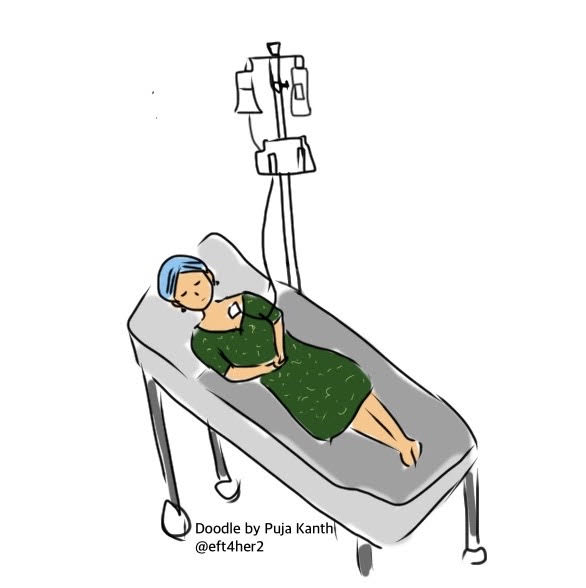
My Tapping Journey with HER2+Breast Cancer (Part 1)

When I was diagnosed with HER2 positive breast cancer 9 months ago, I wasn’t prepared for the long arduous journey ahead. Yet with EFT and creative interests, I’ve navigated chemotherapy, targeted therapy, surgery and radiation.

Last May, I went to the hospital for a checkup that changed my life.

That day when I went alone to the hospital, all I cared about was finding out why the lump in my breast was growing. I had a checkup done a year back and everything was normal. The doctor sounded very concerned after seeing me and sent me to a surgeon. They insisted that I get a FNAC asap.

I went for an FNAC that same afternoon.

Diagnostic Tests

FNAC without anesthesia is a painful process. I tapped on my finger tips to endure the pain. I used some EFT statements such as,

Even though it’s  going to be painful, I trust my body to handle it.

Even though all this is very scary, I still accept myself and I will get through this.


The FNAC report came a week after and it said, suspicious of malignancy. That’s when I knew with absolute certainty that I had cancer.

While I was terribly scared of it, a part of me also felt relieved that finally whatever I was scared of, I was face to face with it.

I braced myself for the journey ahead & EFT helped me at every step of the way.


Even though I never thought that I could get this, a part of me knew that something was wrong.

Even though it’s going to be an ordeal and I don’t know how I’ll handle it, I love and accept myself

Even though my mind is going to WHY did I get this, I’d like to stay with the HOW to get over it, for now.


Next step was to search for a better facility to take this forward. I met with an Oncologist and was asked to go for mammogram, Ultra sound, Biopsy & many other tests.

Biopsy and the other tests were  uncomfortable and some painful. Going through the multiple tests was an ordeal in itself.

During the pre-diagnosis phase, I used EFT to cope with the pain, anxiety and discomfort of the numerous diagnostic tests.

I was tapping on my fingertips before every test, especially during the PET Scan & MRI.

During MRI, I kept saying to myself, “You can do this. Just hold your position. Just a few more minutes”, and imagined tapping on my face points.


Diagnosis

The biopsy results came and the diagnosis was Invasive breast carcinoma with HER2 positive. It’s an aggressive form of cancer which can spread rapidly but the good news was that it would respond well to treatment.

I’ve divided the treatment journey into 3 parts: Chemotherapy, Surgery and Radiation and I’ll be elaborating on how tapping kept me sane during each phase of the treatment.


Tapping through Chemotherapy

My first chemo came right after the chemo-port surgery and it was intense. Not only was the pain debilitating, I was put on 4 drugs the very next day. It was Chemotherapy plus targeted therapy at once due to the aggressive nature of the ER positive Cancer.

I tapped on my fingertips throughout the first chemo and kept repeating the following statements. I used positive language in the second half of the setup statements.

Even though I am going through chemo, my body accepts this treatment to help eliminate the cancer cells .

I wholeheartedly embrace this treatment to allow my body to heal.

I trust my medical team to help me heal fully.


For the pain, I used variations of the setup:

Even though the pain is terrible, I deeply ne completely love ahead accept myself. 

Even though the pain isn’t lessening, I ask my mind and body to be able to handle it with compassion. 


The months that followed during each chemotherapy treatment felt nearly impossible to cope with.

Each day was a roller coaster ride.

The severity of the side effects was strongest in the first ten days. After that some symptoms reduce, while others linger. But not a single day after chemo was symptom free.

When the pain, tightness or other symptoms came up, I let them arise, I stayed with them in silence. I’d lie down and observe them. I would play the music in the background. I focus my attention on the severest physical problem at a time and then shift it to the music. This type of oscillation soothed me and helped in staying with the physical issue.

I coped with the symptoms by staying with them with tapping.

Even though this is intense, I am noticing it.

Even though I have tightness and my chest feels like it’ll explode, I love and accept myself.


Tapping helped in reducing the fear of the symptoms never going away.

Even though this feels like forever, I deeply and completely accept myself.

Even though it’s taking forever for these symptoms to leave and I’m frustrated,  I accept how I feel.

Even though I’m frustrated that these symptoms don’t seem to leave,  I choose to remind myself that this will not last forever. 

Even though it’s very frustrating and overwhelming to experience these symptoms/pain/discomfort, I would like to remember that the symptoms/pain/discomfort will eventually lessen.


With the help of tapping I was able to stay more present and not give to fear and anxiety during the 4 months of chemotherapy.

When the tests were done again to check the progress, my tumour size was barely noticeable in the scans. However the margin rained and they were taken out during surgery.


Self-regulation and Co-regulation

We react to perceived threats most of the times. The painful writings on the walls from our past, aka beliefs, assumptions etc drive our day to day reactions. It’s usually the perceived threat that causes our nervous system to get into FFF responses.

For example, if you are visiting a dentist and you’re feeling very anxious, it’s because of the painful writings on the wall from the past. Maybe your last visit to the dentist was very uncomfortable and you are carrying that “painful past learning” and it’s “intruding into your present”.

If you look at it from the lens of the Nervous system, you’ll understand that your body isn’t against you, it’s just behaving as it should when it perceives threat. It will react in the same way as it would to real threat. The key is to learn self regulation and relaxation techniques that can take your nervous system out of the sympathetic state (FFF) into the parasympathetic state (rest/digest).

(Goes without saying that trauma informed therapy is also a must if you’ve been through any kind of trauma)

What is self-regulation?

The ability to gauge how your body responds to different kinds of stimuli and decrease the tension in the body before it escalates. In other words, it’s the awareness of your body’s sensations and being able to bring them down before they increase.

What is Co-regulation?
I define it simply as “when someone’s calm can ease your chaos/distress.”

Children who’ve had attuned parents who were able to soothe them during times of distress, have greater ability to self-regulate when they grow up.

For example, when a baby cries, the caregiver makes soothing sounds and attends to the baby. When a child is overwhelmed, the caregiver uses their own regulated state to calm the child.
All these are instances of Co-regulation.

Stephen Porges says, “There’s an overall paradox in that individuals who appear to be efficient in regulating themselves are the ones who have had more opportunities to effectively co- regulate with others. Their nervous system has a history of neural exercise that would promote resilience.
In contrast to the older more traditional model that would argue that if an individual was supported too much, the experience of support would compromise the individual’s ability to take care of themself. I believe this a misunderstanding of the needs of humans.
Humans need to be co- regulated, because the experience of being co-regulated develops resilience that will enable a human to self-regulate in the absence of opportunities to co-regulate.”

And did you know that Tapping with someone is also a process of co-regulation?

Join the Trauma Study Circle to learn more about Trauma and EFT.

Reference: Eric Gentry and Robert Rhoton ( CCTP course)

From Rescuing to Self-Love: Uncovering the Inner Child Connection

Rescuing others can be a subtle form of control, often driven by the unconscious hope that being a “rescuer” will earn love in return. This dynamic stems from a belief that the act of rescuing will fill the void created by a lack of self-love.

When viewed through the lens of inner child work, this pattern begins to make sense. During an EFT (Emotional Freedom Techniques) session focused on inner child healing, one client uncovered childhood trauma that left her younger self yearning for protection. As a child, she had endured abuse without anyone to protect her.

Through tapping and connecting with this younger, wounded part, she realized that her inner child was still waiting to be rescued and protected. By processing layers of emotions and offering compassion to that part of herself, a profound shift occurred. The younger self no longer felt the need for external protection but instead felt free to play and experience joy independently. As a result, her adult self began to let go of the compulsion to seek external rescuers or play the role of one. Although more healing was needed, she felt freer to care for herself without waiting for someone else to fill the void.

Healing unresolved trauma through tapping often brings a newfound ability to confidently care for oneself, reducing the tendency to rescue others or seek rescuers. While a healthy need for love and connection is essential for a fulfilling life, unhealthy dependence and clinginess lead to persistent emptiness.

Codependent behaviors and rescuing tendencies usually arise from unhealed wounds tied to a lack of self-love. This lack often extends to younger parts of ourselves—hurt, traumatized, and burdened with guilt and shame. These parts, often rooted in childhood, carry unmet needs for love, protection, and acceptance that were not fulfilled by caregivers. To heal, we must extend compassion and acceptance to all parts of ourselves.

Reflection Questions:

  1. Do you feel driven to protect and rescue others because you weren’t protected as a child?
  2. Did you experience abandonment or rejection growing up?

Steps for Inner Child Work:

  1. Identify a part of yourself that feels unprotected, hurt, wounded, or abandoned.
  2. Acknowledge the feelings this part carries. Use EFT to gently explore these emotions.
    • Stay compassionate and present with this part without trying to fix or rescue it. Let the raw, unfiltered emotions surface.
  3. Ask yourself: How old is this part?
  4. Pinpoint a specific event from your past where you felt this way as a child.
  5. Apply the movie technique on this event.
  6. Continue working with these younger parts using EFT and inner child work. Over time, you’ll notice gradual changes in your present patterns of codependency.

Healing takes patience and kindness toward yourself. As you integrate these younger parts, you create space for self-love and authentic, healthy connections with others.

You can learn Inner child work with EFT by attending one of our classes.

Partners of Alcoholics

It can be deeply challenging to be in a relationship with someone who abuses alcohol, whether it’s through regular excessive drinking, weekend binges, or functioning alcoholism. If their behavior makes you feel uncomfortable or unsafe, this is an important moment to seek clarity and create healthy boundaries.

This post is for you—designed to provide insights and support to help you better understand the situation, prioritize your well-being, and navigate the complexities of such a relationship. You are not alone, and there are ways to regain your sense of stability and peace.

Alcohol addiction is a very serious issue that can break families. Not only is it very difficult for the individual in addiction, it is equally difficult for their partners and spouses. While individuals in addiction need a shame-free recovery process and tons of support, their partners need a lot of support too.

First and foremost, alcohol isn’t an excuse for irresponsible and bad behaviour. The more you overlook bad behaviour, the more it will seem that you’re rewarding the bad behaviour. No matter what the reason – how bad someone’s childhood has been or whether someone belongs to a dysfunctional family- it’s not an excuse for someone in addiction to hit their spouse, behave aggressively and/or emotionally/physically/sexually abuse them.

For Partners of Alcoholics:

You are not a rehabilitation center for someone else’s issues. While offering support is admirable, it should only be extended to those who genuinely want help and are willing to respect your boundaries. You cannot support someone who misuses, manipulates, or resents your efforts.

Set clear boundaries about what you will and will not tolerate, and communicate these openly with your partner. Physical abuse is a firm non-negotiable—there is absolutely no justification for your spouse to hit, shove, or behave aggressively, even under the influence of alcohol.

Emotional abuse is equally unacceptable. Addiction often leads to behaviors like lying, manipulation, and gaslighting, driven by the compulsion to drink. In such cases, the addiction often becomes their top priority, with little regard for the partner’s well-being or needs.

Remember, protecting your emotional and physical safety is paramount. Supporting someone doesn’t mean sacrificing yourself in the process.

Here are a list of questions. If you say yes to even two of them, then seek therapy immediately.

Does your partner get violent?
Are they physically aggressive?
Are they using you as a punching bag every time they drink?
Do they binge and vomit frequently and you’re left to clean it up?
Do they drink and drive despite your repeated requests?
Do they come home drunk frequently while you help them go to bed?
Do they cheat and lie and use alcohol as an excuse?
Do they force you to have sex when you’re not willing to?
Do they verbally abuse you while they’re drunk?
Do they binge drink regularly on weekends?
Do they behave in ways that is inappropriate when they’re drunk?
Do they behave inappropriately with others when they’re drunk?

Enabling Behaviours: 

It’s not your fault that your spouse drinks. However, some of your behaviours such as not setting clear boundaries, rescuing, engaging in excessive caretaking, volatile outbursts, controlling etc. can certainly enable the drinking. Partners of alcohol addiction often think that by engaging in all the above behaviours, they can control the alcoholic’s drinking. But control is a fallacy. You cannot control their drinking and stop it for them, if they’re not willing to.

Some general guidelines on how to handle your relationship.

Are you rescuing them? Are your behaving like a guardian or a mother/father to save them? Maybe they’ve had a bad childhood/ dysfunctional family but they are still responsible for their behaviour when they drink. If after repeatedly setting firm boundaries, they are unwilling to seek help and continue to behave in the same way, you have every right to walk out of the relationship ( if you have a support system). If you find yourself in a society or situation where leaving is challenging—due to cultural norms, lack of resources, or financial dependence—and your life is in danger, prioritize your safety. Reach out to the police or contact women’s organizations for support and assistance.

  • If you decide to support and stay, practice healthy detachment from their issues while you support them. Say NO calmly and frequently to unrealistic demands from your spouse when they’re drinking and sober. Being kind and detached helps.
  • Being clear in your communication that they need to seek help for the problem is imperative, remember you alone cannot fix it.
  • No amount of love is going to solve it unless your partner/spouse is willing to put in the work, and seek help. Remember alcoholics heal or anyone heals only when they’re are willing to. Just because it’s difficult to give up drinking isn’t an excuse to subject you to physical or emotional abuse.
  • Say no to sex if you don’t want to have sex. If you hate the smell, the drunkenness and don’t find it inviting, you have every right to refuse sex.
  • Make sure your seek therapy to handle your mood changes. There will be guilt, frustration, helplessness, rage, anger, etc. You might feel there’s something wrong with you. Seek help from a psychologist. Yes, your partner needs help but you need it more as you’re dealing with the effects of their drinking. Remember self-care precedes others’ care.
  • If you have children, it’s crucial to assess early in the relationship whether your spouse exhibits aggression, violence, or cruelty. Be mindful of how their behavior impacts your child’s well-being. In such cases, separation or divorce is often a healthier option than exposing a child to an emotionally volatile environment. Prioritizing a stable and nurturing atmosphere is essential for their development.
  • Place the onus of their actions on them in a calm and clear manner; shouting, ranting, raging – doesn’t work.
  • But most of all decide what works for you. It’s time to think about yourself instead of what the society thinks, etc. Build your self esteem that’s been eroded due to the relationship and the alcoholism and start afresh. It’s not going to be easy but let’s put it in perspective – even staying with an alcoholic isn’t easy. Hence, even if it’s difficult to stay alone, it’s still a choice you that you’ve made. Choose ‘your kind of hard’ instead of others choosing it for you.

The Importance & Power of Accredited EFT Training

In this training we will dive into the skills and techniques of Emotional Freedom Techniques (EFT).

I wanted to share the immense benefits of attending an accredited EFT training and stress on the importance of practicing EFT in the EFT classes.

Module Structure:

This EFT training is designed with precision. Each module builds upon the last, providing a comprehensive understanding of EFT principles. Learning the foundational skills will help you embark on a journey that empowers you to master the art of eft application.


Demonstrations:

We know that learning through observation is key. The training includes live demonstrations and when you see the techniques in action, you’ll gain insights into the subtleties of applying EFT effectively. These demos bridge the gap between  theory and practice, making your learning experience truly immersive.


Practice Sessions:

Practice makes perfect, and EFT is no exception. Thus online training incorporates hands-on practice sessions where you’ll apply EFT under guidance. These sessions create a supportive environment for honing your skills, ensuring you feel confident using EFT in real-life situations.


Engaging Content:

This is an engaging and participative course where you won’t be a mere passive recipient of the information. You’ll get to engage with fellow learners, share experiences, and receive feedback. This safe environment enhances your learning journey, providing additional perspectives and encouragement.


Flexibility of Online Learning:

The training is every Saturday for 3.5 hours which helps in absorbing information more easily without getting overwhelmed by too much information.


Certification and Accreditation:

Upon completion, you’ll receive a certificate of attendance from EFT international. After the training, you can undertake mentoring for certification to become a certified EFT Practitioner, which will establish and enhance your credibility as an EFT practitioner.


Conclusion:

The modular structure, live demonstrations, practice sessions, engagement, and the flexibility of online learning converge to create an unparalleled training experience. Unleash the power of EFT and transform lives, starting with your own. Join us in unlocking the path to emotional well-being!


Do you have a difficulty in cultivating relationship/friendship with others?

In our culture, IQ is given more importance than emotional intelligence. Having emotions is seen as a sign of weakness which leads to unhealthy expressions of emotions. The following are signs of emotional immaturity that can lead to difficulty in cultivating healthy and meaningful relationships with others.

SIGNS OF EMOTIONAL IMMATURITY THAT RESULT IN ISOLATION & LONELINESS 

Lack of emotional-awareness:

A lack of understanding of feelings leads to the inability to express them in healthy ways. For example, healthy anger helps in drawing firm boundaries whereas unhealthy expressions of anger lead to violating others’ boundaries.

  1. Inability to recognize and label one’s feelings.
  2. Inability to acknowledge negative feelings. Denying, suppressing or acting impulsively on feelings.
  3. Feeling guilty for having negative feelings like jealousy, envy, anger.
  4. Suppressing feelings and then lashing out at someone or a situation all at once.
  5. Instead of acknowledging what you are feeling, and acting in accordance with your values, reacting to people and situations.
  6. Reacting instead of responding to situations and people frequently. Being reactive every day – Shouting, raising voice, agitated speech, angry outbursts or being numb and passive-aggressive.

Signs of unresolved trauma:

The following are just some signs of emotional immaturity that result from having experienced trauma or adverse experiences. For example, divorce, death of parents at a young age, abuse, neglect, domestic violence etc. can impact the development of emotional quotient.

  1. Persistent fear of being judged by others.
  2. Fear of being abandoned.
  3. Misinterpreting information, words, messages by other people.
  4. Always looking for signs of rejection by others (when they’re not actually rejecting you).
  5. Looking for signs of being judged, and misinterpreting information as being a judgment (when people are not being judgmental in reality).
  6. Rehashing every situation or what has been said multiple times in your mind and seeing situations bigger than what they are.
  7. Making up words and reactions in your mind. Although all of us react according to the way we see situations, when we make up things because of rehashing situations many times, it’s very unproductive. Our mind has a habit of adding details, every time we remember something. Let’s say you’re angry with someone, you’ll see things as bigger than they are every time you recall the conversation. When the mind is agitated, it’s very easy to see the situation bigger than it is.
  8. Projecting your own feelings onto others. For example, suppose you’re angry, you think the other person is angry while they’re not.
  9. Thinking that the world is out to get you -Looking at everyone with suspicion as if they have hidden ulterior motives and are out to harm you. ( There are some people who do intentionally harm and we need to recognize and stay away from them but if you’re looking at everyone/most people with suspicion, then it’s a different story).
  10. Having unpredictable behaviour pattern with people – getting too close too soon and then cutting all contact.
  11. Overexplaining each and every behaviour of yours to others and getting defensive very easily.
  12. Getting offended very easily by others remarks or taking things too personally.


Boundary Issues

  1. Putting on a smile even when you don’t like what is being said or done.
  2. Saying yes to every favor and then resenting the people you helped.
  3. Trying to empathize without understanding the context – Thinking that others will respond the same way as you would if you were in their shoes without taking into account their unique situation which may be similar to yours but isn’t the same.
  4. Emotional dumping – Dumping all of your problems and situations on every person you meet.
  5. Sharing indiscriminately – Lack of discretion when it comes to sharing your personal life and stories. Sharing everything with everyone.
  6. Lack of boundaries – Instead of speaking up when someone violates your boundaries, you end up storing all hurts and resenting them.
  7. Building a wall around yourself to protect yourself from getting hurt – Not letting people into your life and then claiming that you are misunderstood and that everyone else, but you, is to be blamed.
  8. Anticipating others needs and doing things for them without them asking for it, then resenting them for not appreciating you or pointing out all the times you’ve helped them.

Lack of Inter-personal communication skills:

  1. Blurting out every thought and feeling indiscriminately to everyone.
  2. Not filtering your words and tone in sensitive conversations.
  3. Imposing your views on others and arguing every point.
  4. Not taking responsibility for your part in a conflict.
  5. Having no clue about how to repair conflicts.
  6. Never taking initiative to repair conflicts.
If you’re displaying the signs mentioned above, people in your life may have difficulty in dealing with your venting, emotional outbursts, emotional volatility and eventually may distance themselves from you which in turn will make you feel that you’re misunderstood or worst, victimized. ( I’m not talking about genuine situations where you have been victimized).
This in turn will make you isolate yourself, think that people and the world are against you, no one understands you which in turn will just increase your loneliness, frustration, anxiety and sense of being misunderstood. It’s a vicious cycle.
Also, the above signs will make it difficult for you to cultivate and sustain meaningful relationships with others.
What can help?
  1. If you have unresolved trauma, see a trauma therapist.
  2. Start by being honest with yourself about your feelings. Every feeling is legitimate and important but if you suppress them and express them inappropriately, these feelings will only intensify, and hurt you and others. Learn more about feelings by reading Emotional Intelligence by Daniel Goleman and/or The Language of Emotions by Karla Mclaren.
  3. Learn simple stress management techniques and practice them daily.  EFT can help.
  4. Learn how to regulate your feelings.
  5. Build 1-1 relationships/friendships with people and make an effort to interact with them regularly. How to break up with your friends by Erin Falconer is a really good book on “finding meaning, connection and boundaries in Modern friendships.”
  6. Take responsibility for your mistakes instead of always blaming others. Look within to see what is making people distance themselves. While it’s true that you may be misunderstood, it’s also true that your emotionally volatility and reactivity don’t allow people to have a calm and clear conversation with you.
  7. Self-Care: Take up hobbies and take time out for yourself.
  8. Reduce over involvement and controlling behaviour towards your family and friends.
  9. If you’re reacting 5 times in a day reduce the reactivity to once and lesser. Once in a while everyone reacts, but if  it’s frequent, then you need to see what in your environment is making you so reactive. Sometimes when people around us are reactive, we become more reactive as well and vice versa. Sometimes our own misinterpretations, assumptions, and limiting beliefs about others or situations can make us react. Journalling, massage, deep breathing, progressive muscle relaxation can help.
  10. Step away from volatile situations. Don’t get caught up in the drama.
  11. You cannot always understand what others are going through and that’s why sensitivity is required when it comes to interacting with people who are going through a difficult time. The person you’re empathizing with will have different values, belief system, sense of humour, perspectives, life situations than you, and you cannot always understand what they’re going through. What works better is to understand a person’s situation in the light of their circumstances, not your own.
  12. Listen more and give less opinions or advice especially when someone is in pain or suffering.
  13. Even in situations where you were deliberately hurt by others, the only thing you can change is your feelings and attitude about it, not the others. EFT can help in releasing negative thoughts and feelings and helping you feel more empowered by coming out of the victim stance.

Please note: These suggestions don’t apply to everyone. There are some situations where others deliberately hurt us, and are violent or abusive. In these situations, it’s normal to feel scared, angry, frustrated and develop subconscious limiting beliefs as a result of the trauma. However, in order to change, the impact of the trauma will have to be processed and finally one will have to work through the layers of trauma etc. to heal oneself. It’s good to allocate responsibility for trauma to others because obviously you didn’t invite the abuse or violence. It happened and you cannot be blamed for it but at the same time you are the only one who can change, heal and transform yourself, and not the perpetrator.


8 reasons to join EFT International

 By certifying as a Practitioner and/or Trainer with EFT International, the largest EFT organization, practitioners gain professional recognition and credibility.
  1. Being affiliated with a reputable organization will add to your professional standing and validate your expertise in EFT.
  2. Membership in EFT International provides access to a global network of students, practitioners & trainers .
  3. EFT International upholds high standards and code of ethics for all its members. Joining the organisation demonstrates a commitment to professional integrity, ethical practice, and maintaining the highest level of EFT skills.
  4. Each member has to fulfil the annual requirement of 6 hours of mentoring and 30 hours of CPD which in turn shows that everyone, no matter what their expertise level, is required to continue to update their skills in EFT.
  5. Listing in practitioner directory – Members are listed in the EFT International Practitioner Directory, a verified resource for individuals seeking EFT practitioners. This directory increases visibility and provides a platform for potential clients to find and contact members directly.
  6. Research: The organisation actively promotes research on EFT. Also, members can attend the EFT international research symposium every year.
  7. Recognition as an Accredited and certified EFT Practitioner: Membership in EFT International signifies that practitioners have met the organization’s rigorous requirements for skills training in EFT. This recognition sets them apart as qualified and skilled professionals in the field of Emotional Freedom Techniques.
  8. EFT International Logo and Branding: Members can get access to the EFT International logo which they can use in their marketing materials, websites, and promotional ventures. This adds credibility to their professional status as an EFT Practitioner.

Benefits of learning EFT in a workshop

  1. Learning EFT is empowering. It is an excellent stress relief and relaxation technique, not just for yourself but also for your clients. The workshop is designed to facilitate the learning of EFT in a calm and regulated environment.
  2. EFT enables people to take charge of their emotional well-being. It’ll help you tap into your inner resources, build resilience and cultivate emotional and bodily awareness.
  3. EFT helps people identify and transform limiting beliefs that are holding them from reaching their full potential. The techniques that you’ll learn in this workshop will help you break free from these limiting patterns in your life.
  4. EFT is a tool than help in building emotional resilience and increase your capacity to handle stress. It equips participants with skills to navigate life’s challenges, bounce back from setbacks and maintain self-regulation.
  5. When you work on your limiting beliefs, you develop better frustration tolerance due to emotional awareness and self regulation technique, your relationships also improve as you learn to resolve conflicts and foster healthier relationships.
  6. It helps in boosting confidence and self esteem. Participants often report releasing self doubt, overcoming diffidence and developing a positive self regard.
  7. EFT workshop also takes you on a journey of personal growth and self discovery.
This workshop has EFT exercises, practice in pairs, group discussions to deepen the understanding and experience the power of EFT firsthand.
I’m a trainer of trainers with EFT International, the largest EFT organization led by dedicated volunteers who adhere to the highest standards of training in EFT. This workshop can help you not just to bring about positive changes in your life but also in that of others – friends and family.

Recovery from hysterectomy with EFT

After avoiding hysterectomy for the past couple of years, I finally made up my mind to go through it two months ago.

A little background

For years I managed my painful period with EFT. I had debilitating pain every month which left me bed-ridden affecting every sphere of my life. With the help of EFT, I was able to ease the frustration and angst that this caused, and take 5 days off every month to rest.

I was diagnosed with PCOD (Polycystic Ovarian Disease) at a young age and then with fibroids. Neither of these conditions were deemed serious enough for surgery, hence my doctor never suggested it. However, about 2 years ago, my doctor finally asked me to go for hysterectomy as my health was deteriorating and it was affecting my quality of life.

Last year when my period started getting worse and started coming twice a month, I knew that I had to decide quickly, but I was petrified of undergoing surgery. I wanted to be sure that I had exhausted all the possibilities of healing my uterus, which in my opinion, I had.

Tapping before surgery

In order to prepare myself for surgery I did a lot of self-tapping and a few sessions with tapping buddies.
Some of the aspects were:
“Even though I’m not sure if this surgery is the right choice, ….”
“Even though I’m scared of surgery,…”
“Even though I’m afraid of general anesthesia, ….”

All this helped in going through the numerous tests and checkups calmly. I was in a Zen like state on the day of the surgery.

But things went downhill right before surgery, emotionally.

When the nurses were prepping me for surgery, they messed up the IV and the intense pain along with the unkindness of one nurse broke my resolve. I was crying right before surgery but I kept tapping on my finger points throughout. My surgery went longer than usual due to some minor complication. The two days that I spent in hospital after surgery felt like a punishment! It was my first hospitalization and I was not prepared, and in a lot of pain. I had tapped so much for undergoing surgery but I forgot to address the aftermath of surgery. In my naïveté or wishful thinking that everything would be miraculously okay after surgery, I didn’t factor in the recovery phase as being difficult.

At one point, the pain was so debilitating, that I tapped on:
“Even though it’s so debilitating, and I feel like I might die, I’m surrendering to the pain and this process.”
This helped calm my nerves and I was able to tolerate more pain as the painkillers were not that effective initially. The rest of the stay in the hospital was filled with small mishaps that left me feeling helpless. These small t’s (traumas) added up and I spent the next 2 months tapping on all of it.


Struggling with symptoms 

As I struggled with ongoing pain, digestive issues, toothache from hell, and food poisoning, during the two months, I frequently felt hopeless and overwhelmed. My biggest fear was ending up in the hospital again.

Some of the aspects I tapped on were:
“Even though my suffering doesn’t seem to end, …”
“Even though I’m not sure when it’ll end, I want to remind myself that I am recovering in small ways everyday.”
“Even though I feel like I’m being punished, …”(This brought up some childhood hurts and I worked on them)
“Even though I’m so angry at the nurses for how unkind they were, … “( Tapped on the VAKOG of this experience)
“Even though I felt hopeless and helpless during my hospital stay, …”
“Even though it’s been a very challenging journey, I would love to have some compassion for myself.”
“Even though I might end up in the hospital again, and although the chances are slim, if it happens it happens. I choose to now come back to the present moment.”

Following a daily tapping routine

I incorporated some positive statements and cognitive shifts into my daily tapping routine. I would tap every morning on these statements:
“I’m safe at this moment.”
“I’m recovering.”
“My organs that were affected by the surgery are healing.”
“Healing is slow but it’s definitely happening.”
“I’m allowing my body to take its time to heal. My body knows how to heal. I choose to trust my body.”

Overall, the whole process was very stressful and there were multiple small t’s that had to be addressed, but due to the tapping, I was able to find many tiny moments of calm and peace during this time as well. I was able to appreciate the resources I had, and whenever the discomfort lessened I drew and read a lot.

Tapping, a real gift


EFT has been a life saver for me and continues to be helpful as I struggle with ongoing fatigue and stomach issues. A self regulating as well as relaxation tool, EFT’s USP is its adaptability to any situation.

In my opinion, using EFT on a daily basis for self-regulation when you are going through a physical or emotional hardship is the best gift you can give to yourself. While you cannot change the external circumstances, you can certainly heal what you are going through internally and give yourself hope.

I’m glad that EFT gave me the strength to undergo surgery as it’s only after the surgery that we found additional multiple fibroids which went undetected in scans and would have led to complications in future.